Soleus PNF Stretch
Supine · Soleus
A PNF stretch for the soleus, combining a gentle push with relaxation.
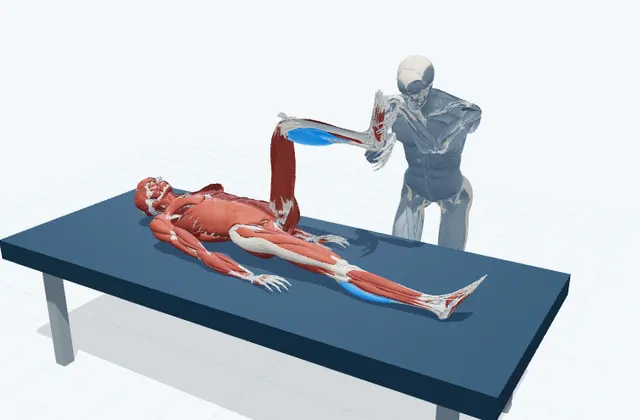
Position and focus
Supine · Soleus
Starting position
The client lies supine with the left hip and knee bent to 90 degrees. The trainer supports the heel and the ball of the foot.
Movement phases
1. Move to the stretch
Keeping the knee bent, flex the ankle and stop where the client feels a light, pain-free stretch.
2. Push and hold
The client gently pushes the ball of the foot into the trainer's hand as if pointing the toes while the trainer holds the limb still for about 6 seconds. Keep breathing.
3. Relax
Ask the client to relax and check that they have fully let go.
4. Move into the new range
Without bouncing, the trainer moves the limb a little further, to a new position where the stretch is felt.
5. Return to the start
Keep supporting as you return to the starting position, and ask how the client feels and check for any symptoms.
PNF method
Hold-relax
At the stretched position the client pushes gently while the trainer holds still. After relaxing, the range is increased.
Contract-relax
The client pushes while the trainer resists and lets the limb move slightly back towards the start. After relaxing, the range is increased.
Using the opposite muscles
After the push and relaxation, the client moves actively in the direction of the stretch while the trainer assists.
In the 3D, orange arrows show where the client pushes or moves and blue arrows show where the trainer resists. PNF method names are defined differently across sources; here they are distinguished by the 3D movement. While the client pushes back, the working muscles are shown in orange. The push can be gentle. Reports describe contractions of 3–10 seconds (6 seconds is often recommended); ACSM guidance suggests a 3–6 second contraction at 20–75% effort followed by a 10–30 second assisted stretch. The 3D timing is not a prescription.
What the trainer checks
Check that the knee angle is not changing.
Trainer information
Trainer position
Stand on the client's left (the side shown in the 3D) with your feet apart front to back, at a height that suits the table. Move by shifting your body weight rather than holding with the arms alone.
Contact and support
Cup the heel in the palm and place a hand on the ball of the foot.
Stabilisation
Keep the knee at about 90 degrees.
Compensation
Change in knee angle, twisting of the foot, breath-holding.
Easier option
Reduce the range and let the weight of the leg or arm rest on a cushion or the table. Go back to checking a pain-free starting position.
Cues and consent
Tell the client where you will touch and which way you will move, and say, 'Tell me straight away if you feel any pain or discomfort.' Confirm consent before touching and before moving.
Stop criteria
Return to the starting position immediately if the client reports sharp pain, numbness, weakness, a pinching feeling in the joint, dizziness, shortness of breath or anxiety, or asks to stop.
The sources include material for clinicians and carers. This 3D is not yet fully reviewed as a studio procedure and does not replace hands-on training. Do not perform unfamiliar techniques from the 3D alone.
Caution
Work within your qualifications, contract and studio procedures, and check medical history, medication and any pain before starting. This is not a substitute for diagnosis or treatment. Do not perform unfamiliar techniques from the 3D alone. PNF involves muscle contraction. For clients with high blood pressure, a heart condition, pregnancy or recent surgery, get confirmation from a healthcare professional first. Remind the client not to hold their breath while pushing.
These English notes describe a prototype model. The stretch, foam roller and resistance band lessons are being produced under the supervision of CoconeRu. Move, reviewed in stages. They are not medical advice or an individual exercise prescription.
References
Each note describes what the whole source covers.
Hindle KB et al. Proprioceptive Neuromuscular Facilitation (PNF): Its Mechanisms and Effects on Range of Motion and Muscular Function. J Hum Kinet. 2012 ↗
A review of PNF methods (stretching after a contraction, adding a contraction of the opposite muscles), contraction time (3–10 seconds, 6 preferred) and intensity (reports of similar effects at 20% or 60% of maximum as at 100%).
Worcestershire Acute Hospitals NHS — Stretching Exercises with Assistance ↗
For helpers: where to support and how to move the shoulder (raising and opening), elbow and wrist, double knee hug, knee rolls, inner thigh, front of the hip lying on the side, front and back of the thigh, and ankle.
This lesson was put together for this site from the methods for the same area in the sources above. It has not yet been reviewed by an expert.
About this page
It shows a typical way to do the movement. The 3D is a schematic model; it does not decide whether a lesson suits you, prescribe exercise or diagnose anything. Stop if you feel pain or discomfort.
Sources, supervision and revisions