Supported Hip Internal Rotation
Supine · Hip external rotators (stretched into internal rotation)
An assisted stretch for the hip external rotators (stretched into internal rotation), observing contact, stabilisation and compensation separately.
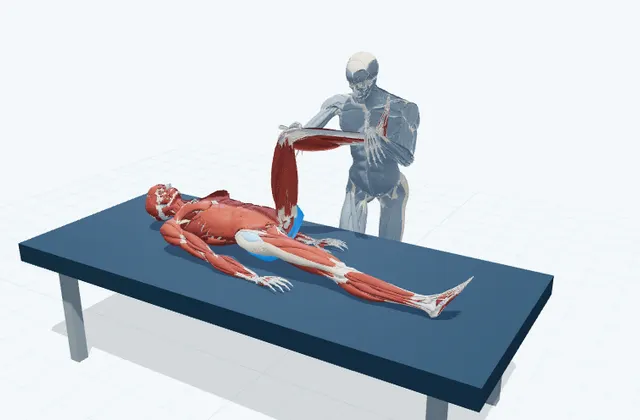
Position and focus
Supine · Hip external rotators (stretched into internal rotation)
Starting position
The client lies supine with the left hip and knee bent to 90 degrees. The trainer stands on the left side.
Movement phases
1. Support the leg
Place the hands on the outside of the knee and the inside of the ankle.
2. Move the ankle outwards
Keep the knee in place and move the ankle outwards.
3. Check the response
Check for a stretch in the buttock and any pinching at the front of the hip.
4. Return to centre
Return the leg to the starting position.
What the trainer checks
Check that there is no pain on the inside of the knee and that the pelvis is not lifting.
Trainer information
Trainer position
Stand on the client's left (the side shown in the 3D) with your feet apart front to back, at a height that suits the table. Move by shifting your body weight rather than holding with the arms alone.
Contact and support
Support the thigh at the outside of the knee and place the palm on the inside of the ankle and push it outwards.
Stabilisation
Hold the knee in position in the air and let the pelvis rest on the table.
Compensation
Lifting of the pelvis, pressure on the inside of the knee, movement of the foot alone.
Easier option
Reduce the range and let the weight of the leg or arm rest on a cushion or the table. Go back to checking a pain-free starting position.
Cues and consent
Tell the client where you will touch and which way you will move, and say, 'Tell me straight away if you feel any pain or discomfort.' Confirm consent before touching and before moving.
Stop criteria
Return to the starting position immediately if the client reports sharp pain, numbness, weakness, a pinching feeling in the joint, dizziness, shortness of breath or anxiety, or asks to stop.
The sources include material for clinicians and carers. This 3D is not yet fully reviewed as a studio procedure and does not replace hands-on training. Do not perform unfamiliar techniques from the 3D alone.
Caution
Work within your qualifications, contract and studio procedures, and check medical history, medication and any pain before starting. This is not a substitute for diagnosis or treatment. Do not perform unfamiliar techniques from the 3D alone. For clients who have had a hip replacement, do not take the hip into deep bending, inward crossing or inward rotation; follow their healthcare professional’s instructions.
These English notes describe a prototype model. The stretch, foam roller and resistance band lessons are being produced under the supervision of CoconeRu. Move, reviewed in stages. They are not medical advice or an individual exercise prescription.
References
This lesson was put together for this site. It has not yet been reviewed by an expert.
About this page
It shows a typical way to do the movement. The 3D is a schematic model; it does not decide whether a lesson suits you, prescribe exercise or diagnose anything. Stop if you feel pain or discomfort.
Sources, supervision and revisions