Side-Lying Femoral Nerve Glide
Side-lying · Femoral nerve pathway (front of the thigh)
Small, pain-free movements to glide the femoral nerve pathway (front of the thigh).
How longNew to it: 5–10 movements in a small range with no numbness. Used to it: 10–15 movements, 1–2 sets.How long and how many →
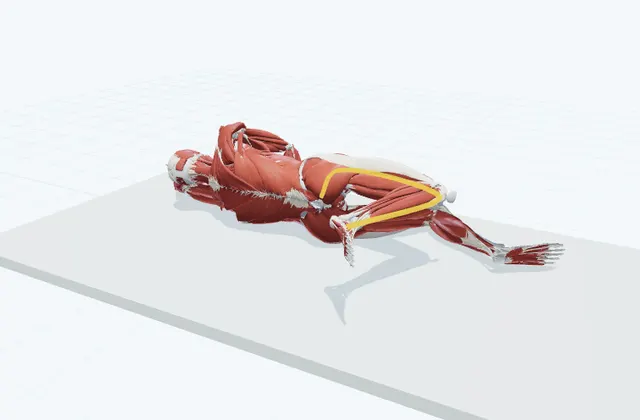
Position and focus
Side-lying · Femoral nerve pathway (front of the thigh)
Starting position
Lie on your left side with the bottom knee bent for balance. Place the top hand on the floor in front of your chest and tuck the chin slightly.
Movement phases
1. Set up
Keep the body lying straight on its side so the pelvis does not roll back.
2. Small movements
Bend the top knee and draw the heel slightly back as you lift the chin. Straighten the knee as you tuck the chin.
3. Slightly larger range
Bend the knee a little further, without arching the lower back.
4. Smaller and stop
Make the movements smaller and stop with the knee slightly bent.
What to check yourself
Check that the lower back does not arch and the pelvis does not roll back as the knee bends.
Adjust the stretch
Easier: Bend the knee less and keep the chin movement small.
Deeper: As long as the sensation does not change, keep the knee bent and take the thigh a little further back.
Caution
Stop if you feel sharp pain, numbness, dizziness, shortness of breath or anxiety. If you are receiving treatment, recovering from surgery or pregnant, check with your healthcare professional first. Think of a nerve glide as sliding rather than stretching, and keep the movements small. Stop if you feel numbness, tingling or pain, or if a sensation stays after moving. If you are receiving treatment for numbness or pain, check with your healthcare professional first.
These English notes describe a prototype model. The stretch, foam roller and resistance band lessons are being produced under the supervision of CoconeRu. Move, reviewed in stages. They are not medical advice or an individual exercise prescription.
References
Each note describes what the whole source covers.
Basson A et al. The Effectiveness of Neural Mobilization for Neuromusculoskeletal Conditions: A Systematic Review and Meta-analysis. J Orthop Sports Phys Ther. 2017 ↗
A review of research on nerve gliding movements (neural mobilisation): combining joint movements to move the nerve pathway a little at a time.
About this page
It shows a typical way to do the movement. The 3D is a schematic model; it does not decide whether a lesson suits you, prescribe exercise or diagnose anything. Stop if you feel pain or discomfort.
Sources, supervision and revisions