Standing Side Plank
Reformer Pilates how-to and muscles worked in 3D
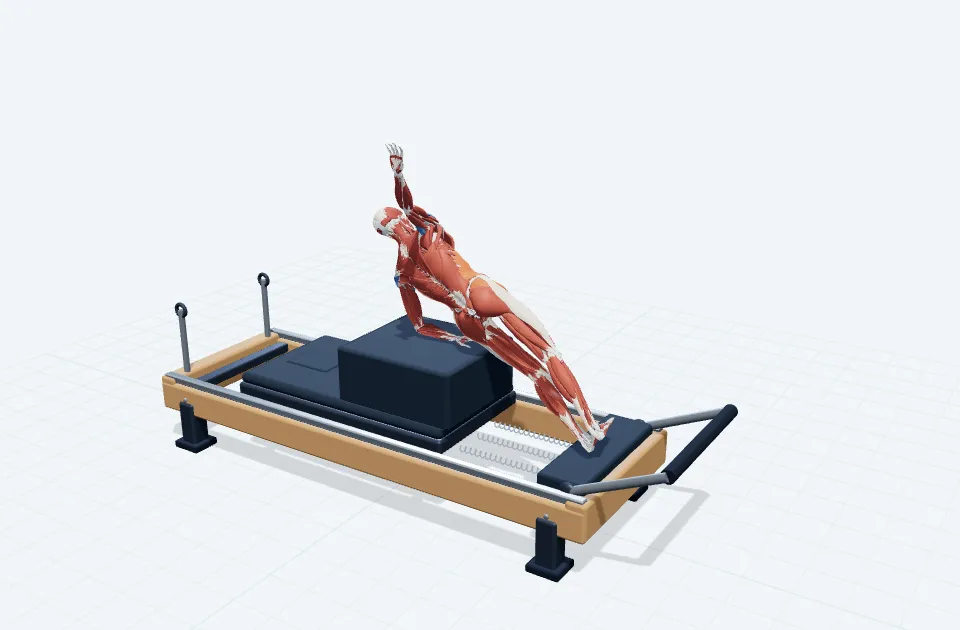
Maintain trunk support while opening the upper arm towards the ceiling.
← Back to the reformer library
Preparation
Rest the lower forearm on the box and stack both feet on the fixed platform at the footbar end. The selected side is uppermost, with a diagonal line from the shoulders to the feet.
Check your equipment manual and the setup taught by your instructor. Model spring colours and dimensions are not equipment settings.
Four movement phases
1. Set up
Rest the lower forearm on the box and stack both feet on the fixed platform at the footbar end. The selected side is uppermost, with a diagonal line from the shoulders to the feet.
Breathing example: Breathe comfortably
2. Movement
Maintain trunk support while opening the upper arm towards the ceiling.
Breathing example: Exhale
3. Observe
Press through the forearm without sinking into the shoulder.
Breathing example: Keep breathing
4. Complete the cycle
Keep the body long as the upper arm returns towards the side.
Breathing example: Inhale
Observation points
Press through the forearm without sinking into the shoulder.
Breathing is an example. Stay within the range you have learned and stop if you experience pain or discomfort.
These English notes describe the prototype model. They are not a personalised exercise prescription or a complete teaching syllabus. The content is being produced under the supervision of CoconeRu. Move and reviewed in stages. This does not provide medical advice or an individual exercise prescription.
Match the name with the movement
The lesson name is Standing Side Plank. Similar names can refer to different setups, support points or teaching intentions. Compare this preparation and its four phases with the variation you learned.
What to check in 3D
- Pause the start and identify contact with the mat, bar or carriage.
- Choose a phase and view the limbs and trunk from another angle.
- Read the return and breathing cue, then note a question for your instructor.