Criss Cross · Controlled Alternation
Mat Pilates how-to and muscles worked in 3D
Keep the right knee bent, turn the chest towards it and extend the left leg. Return to centre before changing sides.
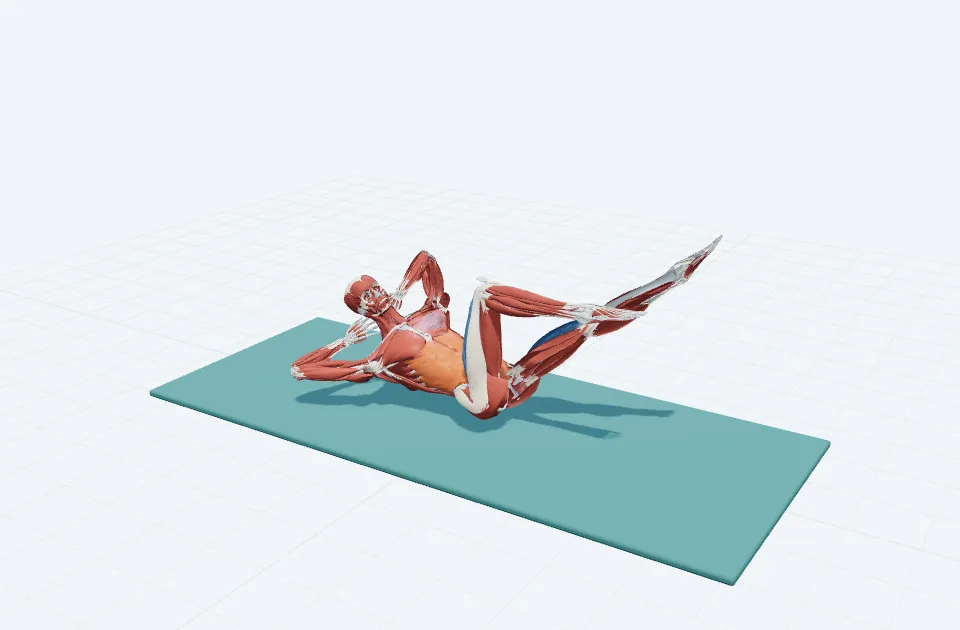
Preparation
Begin supine with both knees in tabletop and the chest slightly lifted. Rest the hands lightly behind the head.
Use a non-slip mat and enough space. Review the method you learned from your instructor.
Four movement phases
1. Centre
Begin supine with both knees in tabletop and the chest slightly lifted. Rest the hands lightly behind the head.
Breathing example: Inhale
2. Turn right
Keep the right knee bent, turn the chest towards it and extend the left leg. Return to centre before changing sides.
Breathing example: Exhale to reach, inhale to return
3. Turn left
Keep the left knee bent, turn the chest towards it and extend the right leg. Return to centre without rolling the pelvis.
Breathing example: Exhale to reach, inhale to return
4. Return to centre
Align both knees and check the position of the chest and pelvis. Do not pull the head with the hands; this model uses slow alternating movements.
Breathing example: Inhale
Observation points
Keep the left knee bent, turn the chest towards it and extend the right leg. Return to centre without rolling the pelvis.
Breathing is an example. Stay within the range you have learned and stop if you experience pain or discomfort.
These English notes describe the prototype model. They are not a personalised exercise prescription or a complete teaching syllabus. The content is being produced under the supervision of CoconeRu. Move and reviewed in stages. This does not provide medical advice or an individual exercise prescription.
Match the name with the movement
The lesson name is Criss Cross · Controlled Alternation. Similar names can refer to different setups, support points or teaching intentions. Compare this preparation and its four phases with the variation you learned.
What to check in 3D
- Pause the start and identify contact with the mat, bar or carriage.
- Choose a phase and view the limbs and trunk from another angle.
- Read the return and breathing cue, then note a question for your instructor.